Valve added Rush to Counter-Strike 2 with the Rush Hour update on September 22, 2026, and explained it in four short bullet points. That is enough to get you into a queue. It does not explain why one match ends 8:3 and the next one 4:0, or why the arenas in your game carry names that are missing from Valve's own Rush poster.
Since launch, Valve has shipped four small patches that touch Rush, and dataminers have taken the mode's config and map script apart. Most of the rules can now be pinned down, so this guide combines Valve's notes with the game files and with what we saw in our own matches, and it flags every number Valve has not published itself.
Our take: Rush plays more like a chain of retakes than a shortened Competitive half. Teams that chase kills instead of the tower lose rounds they thought they had already won, and teams that save money after a lost round are playing the wrong economy. If you want your loadout to look right for the close-range fights, you can trade CS2 skins on SkinsMonkey in a couple of minutes and be back in the queue.
For everything else in the patch (silent reloads, Premier map picks, Clan Tags), see our Rush Hour update breakdown.
Rush Rule One: The Tower Wins Rounds, Kills Only Open the Door
Valve's own description of a round is short: control the tower when you eliminate the enemy team, or when time expires. Wiping the other three players does not end the round on its own. After the last enemy dies, your team gets a short countdown to reach the tower, and if nobody makes it, the round goes to the side that still holds it.
That countdown lasts up to 7 seconds in a standard arena. On September 23 Valve raised the maximum to 14 seconds in the end rooms (the two castles) and in Convoy, and those two numbers are the only timing values Valve has put in writing. The same patch stopped the countdown from starting when a whole team dies to suicides, team kills or disconnects. Mythras, the dataminer who went through the map script, worked out that 7 seconds covers roughly 33 meters at knife running speed. If the last duel happens on the far side of the arena, you can win the fight and still lose the round.
When the clock runs out, the team on the tower wins. Rounds last 40 seconds in standard arenas and 60 seconds in the castles and in Convoy, again from the game files rather than from Valve.
Who holds the tower at the start matters as much as the clock. Round one is always played in the center arena, the Counter-Terrorists own it, and the Terrorists attack. After that, the team that won the previous round attacks the next arena and the team that lost defends from the tower. Winning keeps you on the move, while losing hands you a defensive position and a loss bonus, which is why a Rush match can swing back quickly.
From Big Box to the Castle: How a Rush Match Moves
A Rush match is a row of seven arenas: the Terrorist castle on the left, the Counter-Terrorist castle on the right, one center arena in the middle and two standard arenas on each side of it. The progress bar at the top of the screen shows the whole row, which side holds each arena and where the fight is.
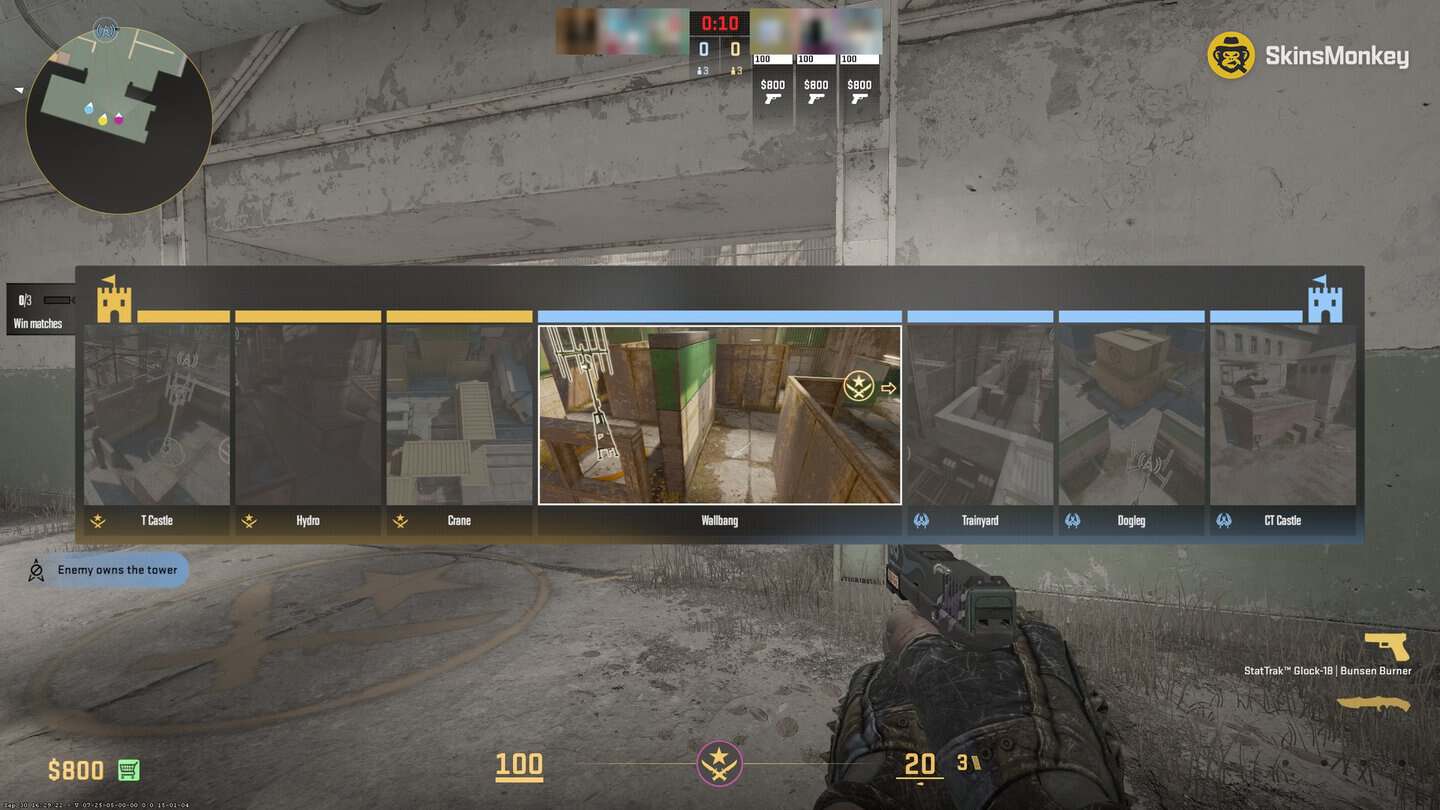
In the match above, Wallbang hosted round one, with Crane, Hydro and the T Castle on the Terrorist side and Trainyard, Dogleg and the CT Castle on the Counter-Terrorist side. As a Terrorist you spawn into that first round with $800 and an “Enemy owns the tower” message, because the CTs always hold the center arena at the start.
Win a round and the next one is played one arena closer to the loser's castle. Lose it and the fight slides back toward yours. In practice it feels like a tug of war, and the match as a whole works like capture the flag, with the enemy castle as the flag.
There are two ways to end it:
- Win a round inside the enemy castle. The fight starts three arenas away from each castle, so a castle capture always comes with a four-round lead. A 4:0 sweep is the shortest match the script allows.
- Reach eight round wins first. We saw matches end at eight on launch night, before anyone had published the files, and the config confirms the limit.
If neither happens and the score reaches 7:7, round 15 is played in Convoy, an arena built on two trains. Convoy takes over the center slot of the progress bar and the game labels it “Final round.” Valve mentioned Convoy by name in the September 23 patch notes, but it is not on the announcement poster. A Rush match therefore never runs past 15 rounds.
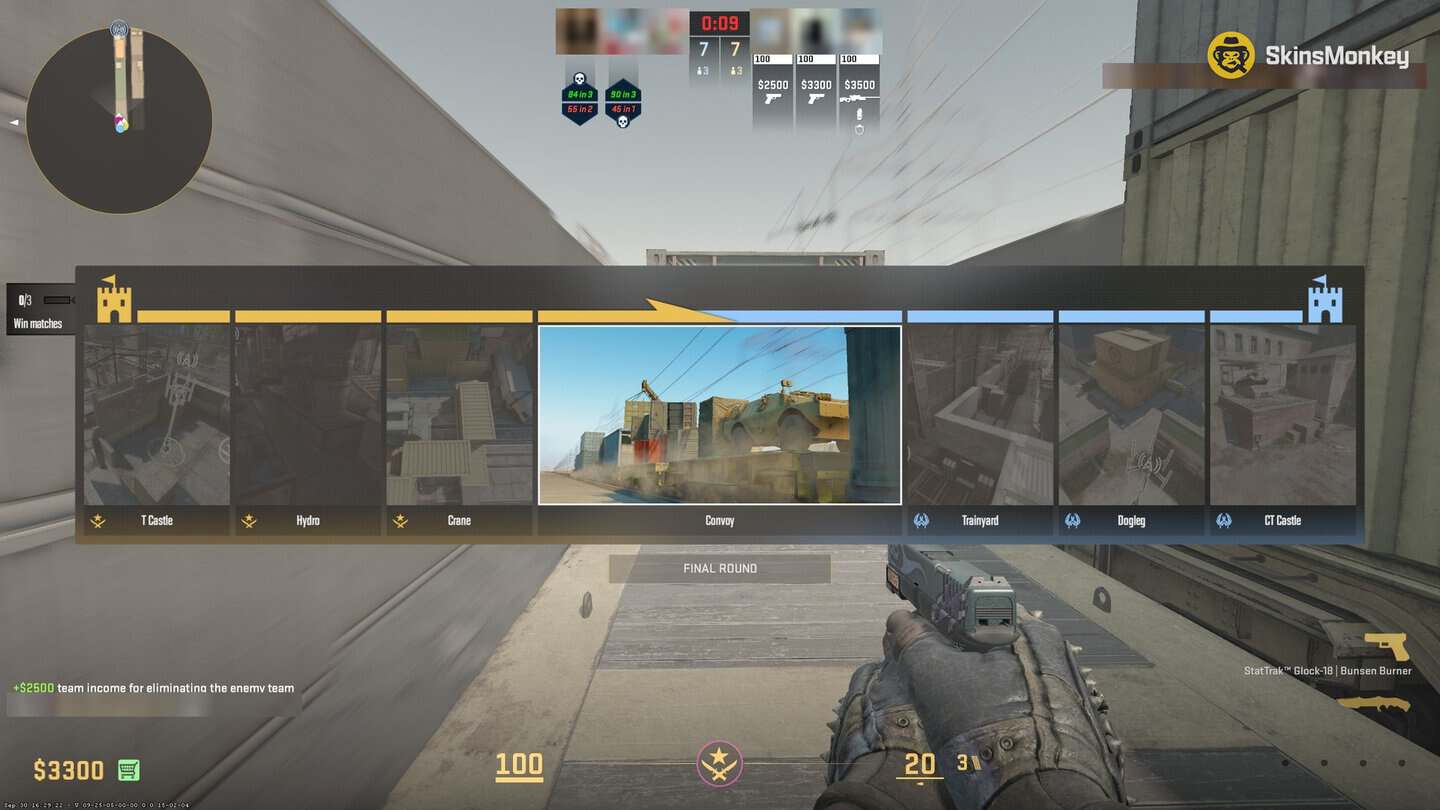
One of our matches went the full distance: 7:7, a final round on the train, and an 8:7 win.
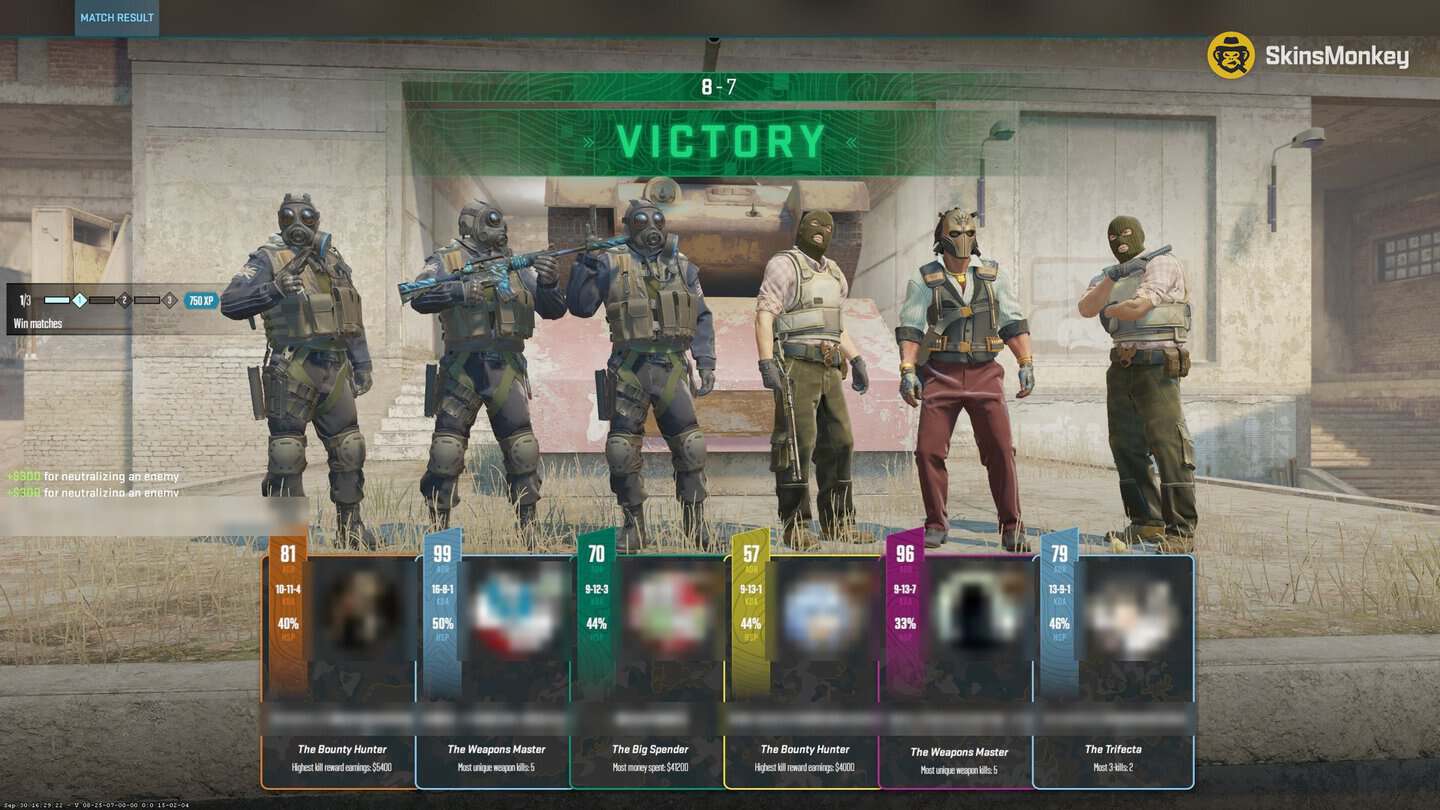
Sides never switch. There is no halftime, so whichever side you load in on is the side you play for the whole match.
Why the Rush Arenas in Your Match Are Not on Valve's Poster
Valve's announcement graphic shows 15 arena layouts: T Assault, Spire, Wallbang, Big Box, Sewer, Dogleg, Drop, Crane, Playhouse, Madhouse, Tunnel, King of the Hill, Marksman, Horseshoe and CT Assault. In our first match on launch night we got Crane (shown as Żuraw, because the client was set to Polish), Dogleg, Big Box, Atomic and Medusa. Atomic and Medusa are nowhere on the poster.
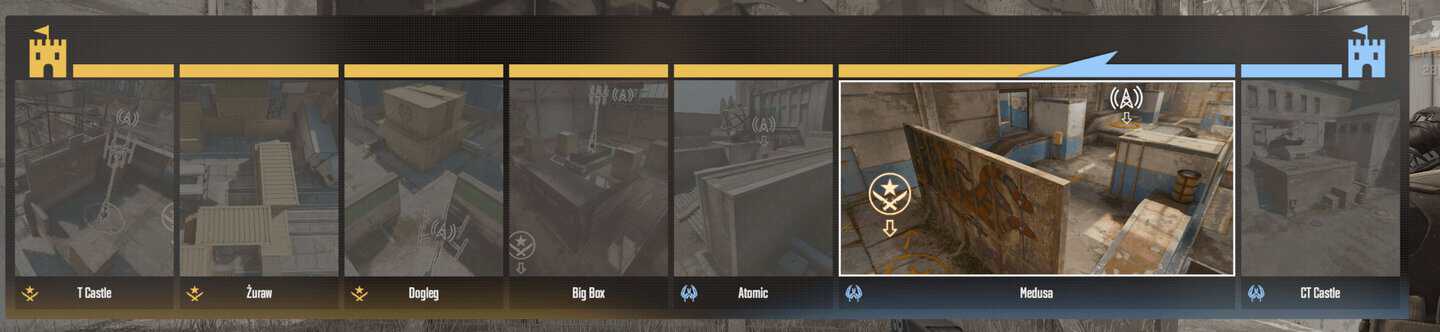
The game files explain it. According to Mythras, who read the map script and the English string file through SteamDB's GameTracking repository, all arenas are rooms of a single map called Complex, and the pool you actually queue into looks like this:
- Center arenas (one per match, always round one): Spire, Wallbang, Big Box, Madhouse
- Standard arenas (four per match): Sewer, Dogleg, Trainyard, Crane, Bloc, Hydro, Atomic, Medusa, Bear, Steel, Container, Drop
- Castles: T Castle and CT Castle, always at the two ends
- Tiebreaker: Convoy
Eight names match the poster. T Assault and CT Assault are most likely the two castle rooms, since they are drawn with team icons. The other five poster names (Playhouse, Tunnel, King of the Hill, Marksman and Horseshoe) have no counterpart in the script or the strings either. Our guess, and it is only a guess based on the drawings, is that some of them are earlier names for arenas in the files: the poster's Tunnel has the long water channel of Hydro, and Horseshoe has the shape of Bear. Our screenshot lines up with the files, with Big Box in the center slot exactly where the script puts a center arena, so the list above is what you will really play.
The numbers also explain why no two matches look the same. With one of four center arenas and four of the twelve standard arenas, in order, there are 47,520 possible layouts.
Every Rush Arena on Complex, One by One
We took every screenshot below ourselves. The layout notes are based on the arena pages of HLA, an independent Counter-Strike community that runs its own servers, and we compared them with Valve's drawings for the eight arenas that appear on the poster.
T Castle and CT Castle
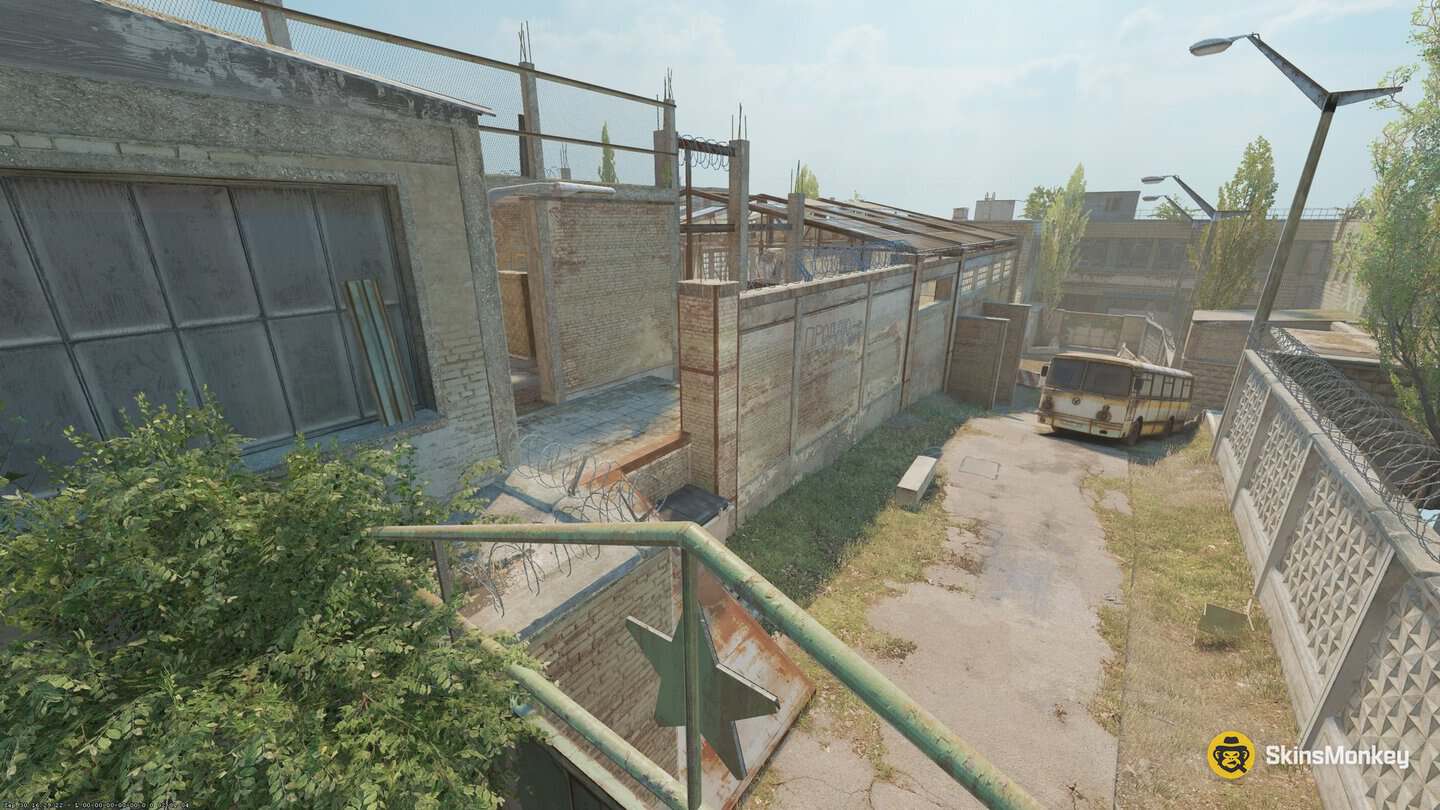
The T Castle sits in an overgrown yard with a rusting bus parked inside. The tower is right next to the Terrorist spawn, so the CTs have to fight their way up to it from lower ground.
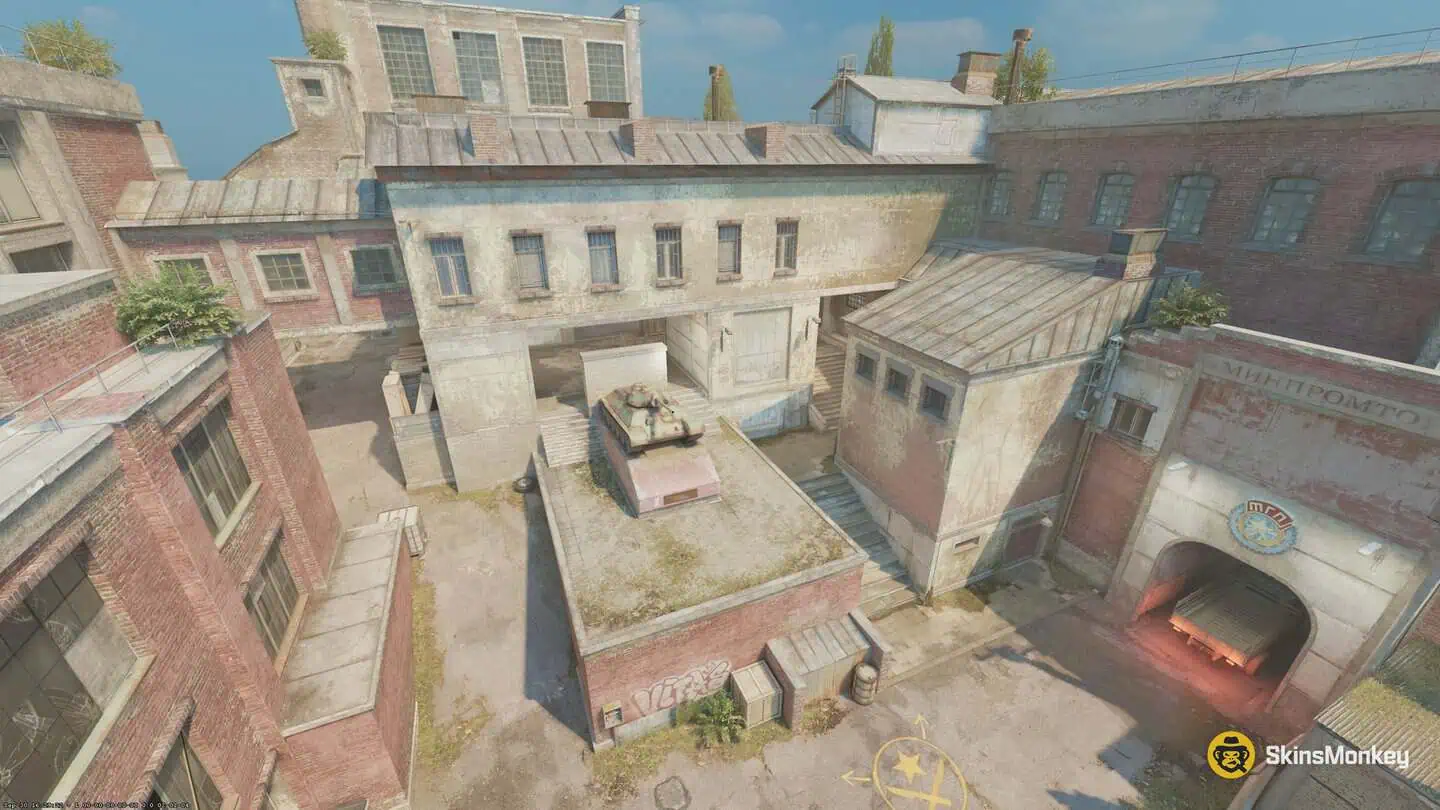
The CT Castle flips that around in a block of brick buildings with a tank on a pedestal in the middle. CTs spawn by the tower, and the Terrorists have to climb several flights of stairs to reach it. Both castles run 60-second rounds, and an attacking win in either one ends the match on the spot.
Spire (center)
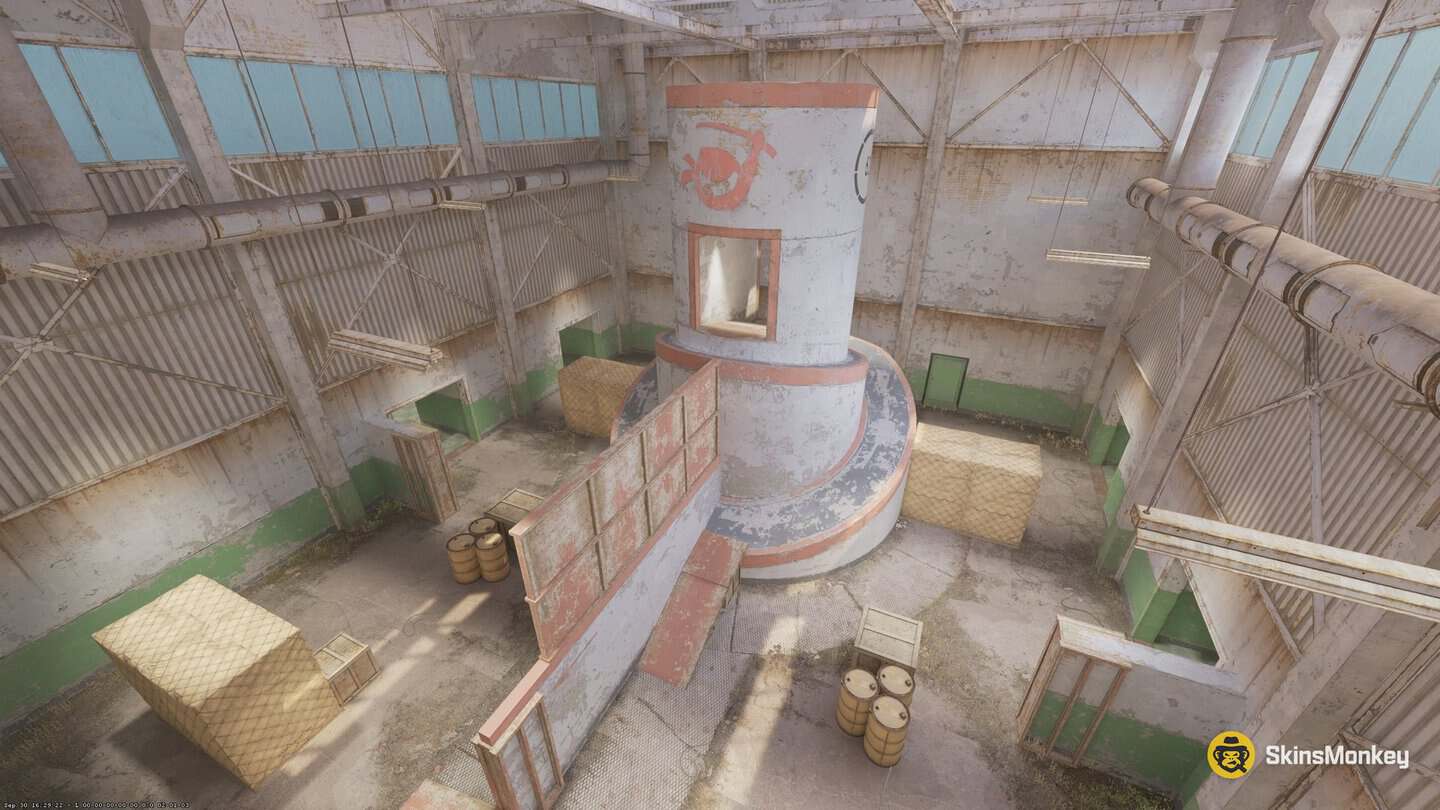
The hall is built around a concrete spire with a ramp wrapping around it. Spawns sit on opposite sides, and the tower is tucked away at the back, the longest walk from both spawns of any center arena.
Wallbang (center)
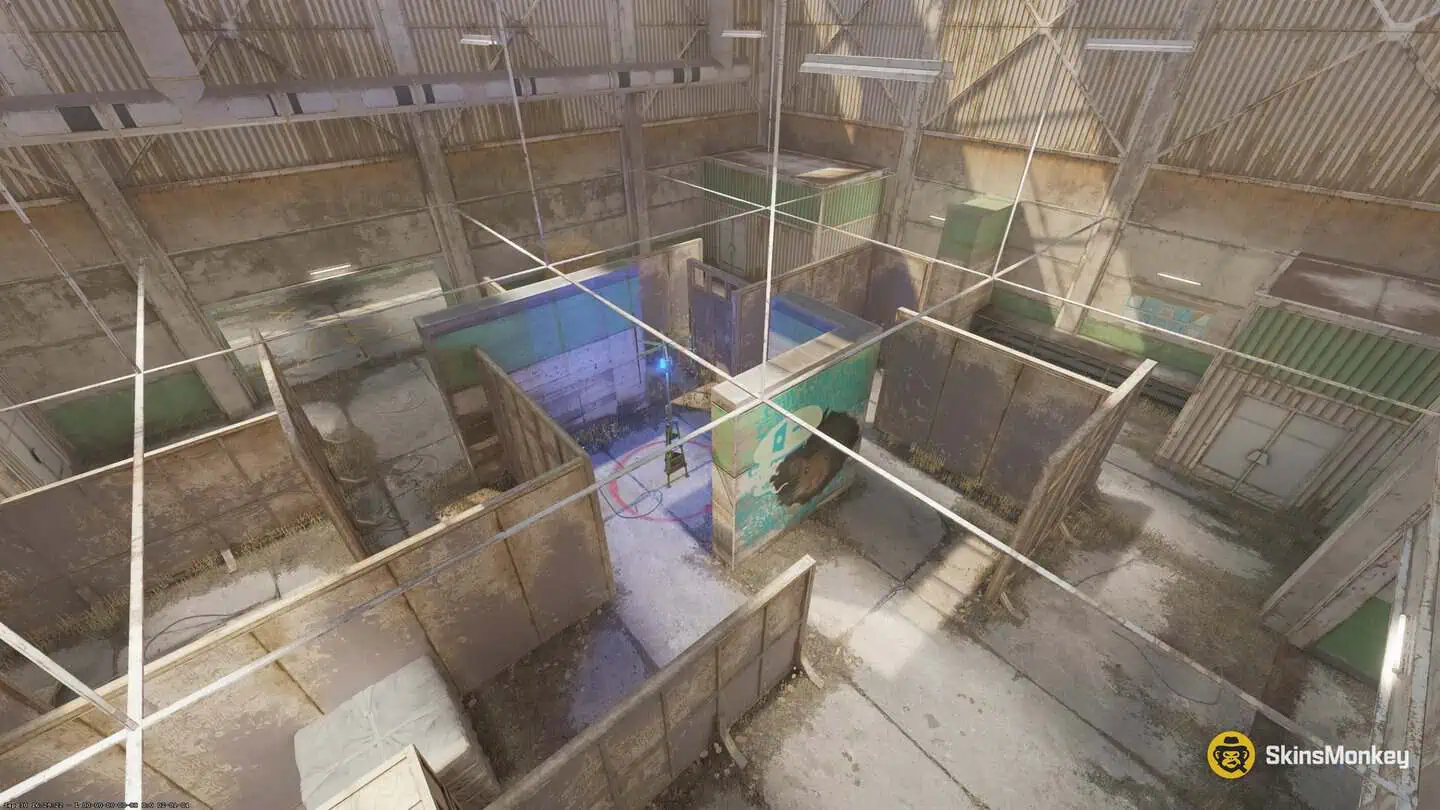
Rows of thin, freestanding walls surround a tower in the middle of the hall. Of the four center arenas, this one has the shortest distance between the spawns and from each spawn to the tower.
Big Box (center)
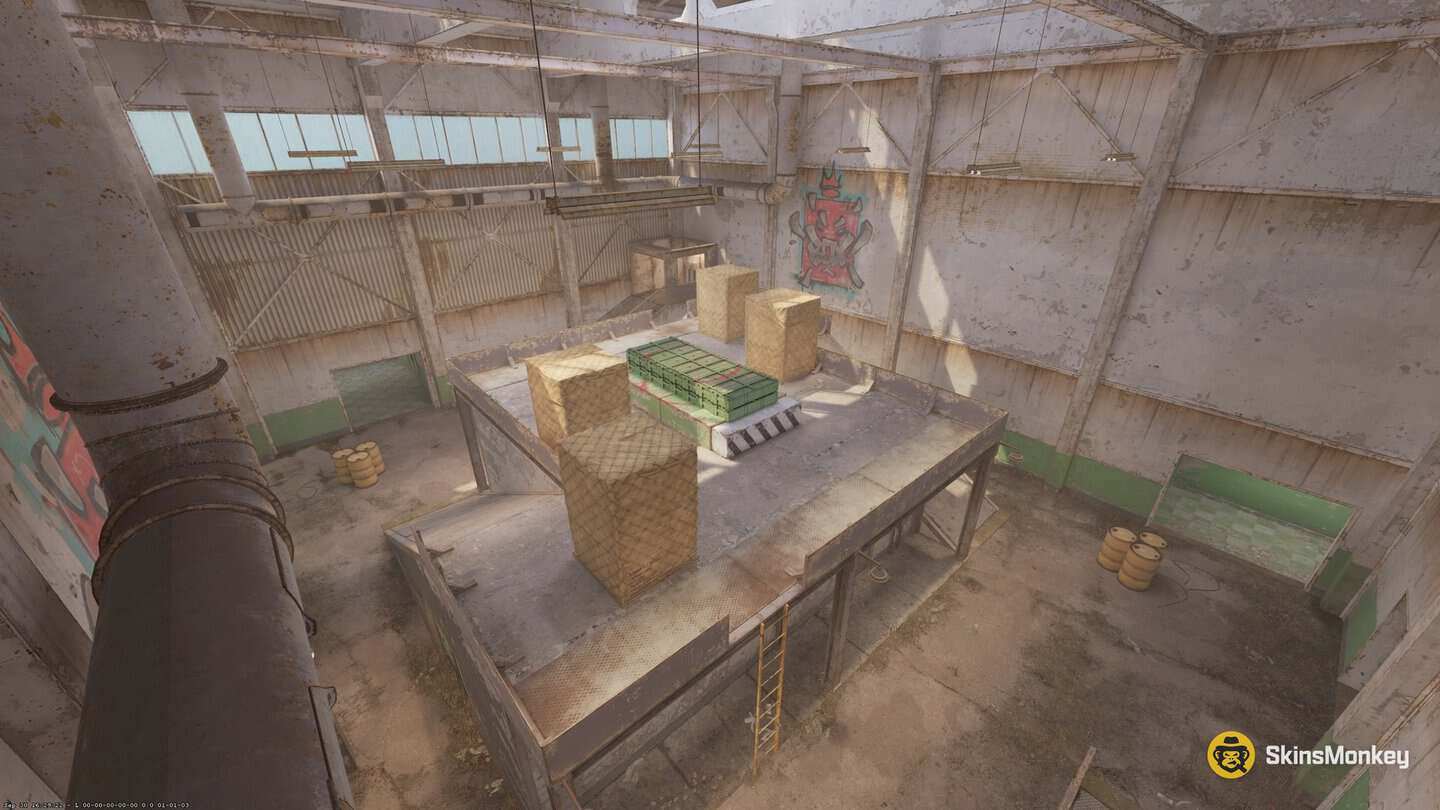
A large raised block takes up the middle of the hall, with the tower on its roof well above both spawns. You get up there by ramps or ladders. The spawns are in opposite corners, the widest gap among the center arenas.
Madhouse (center)
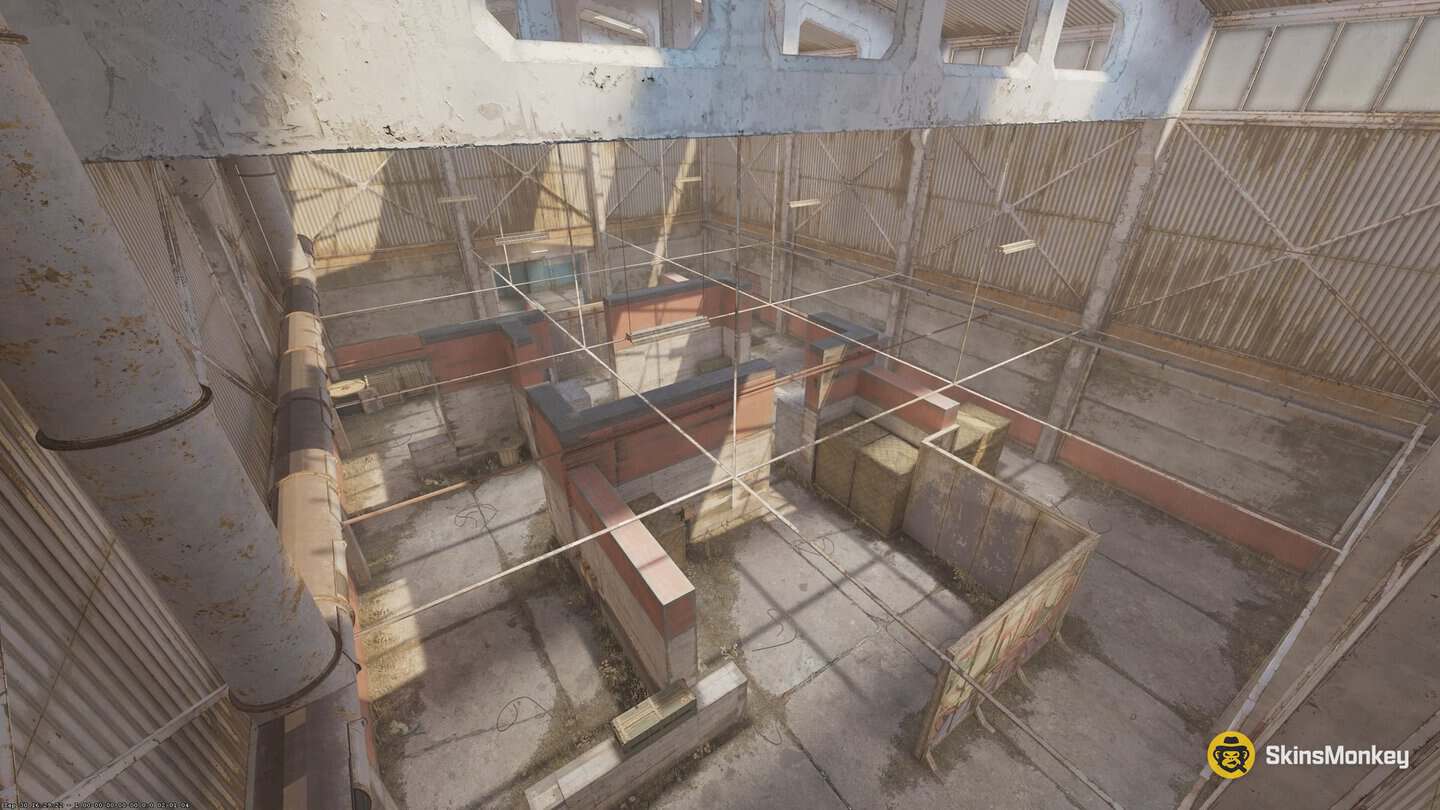
Short walls and crates break the hall into small pockets around a tower in the middle, with the spawns at opposite ends.
Sewer
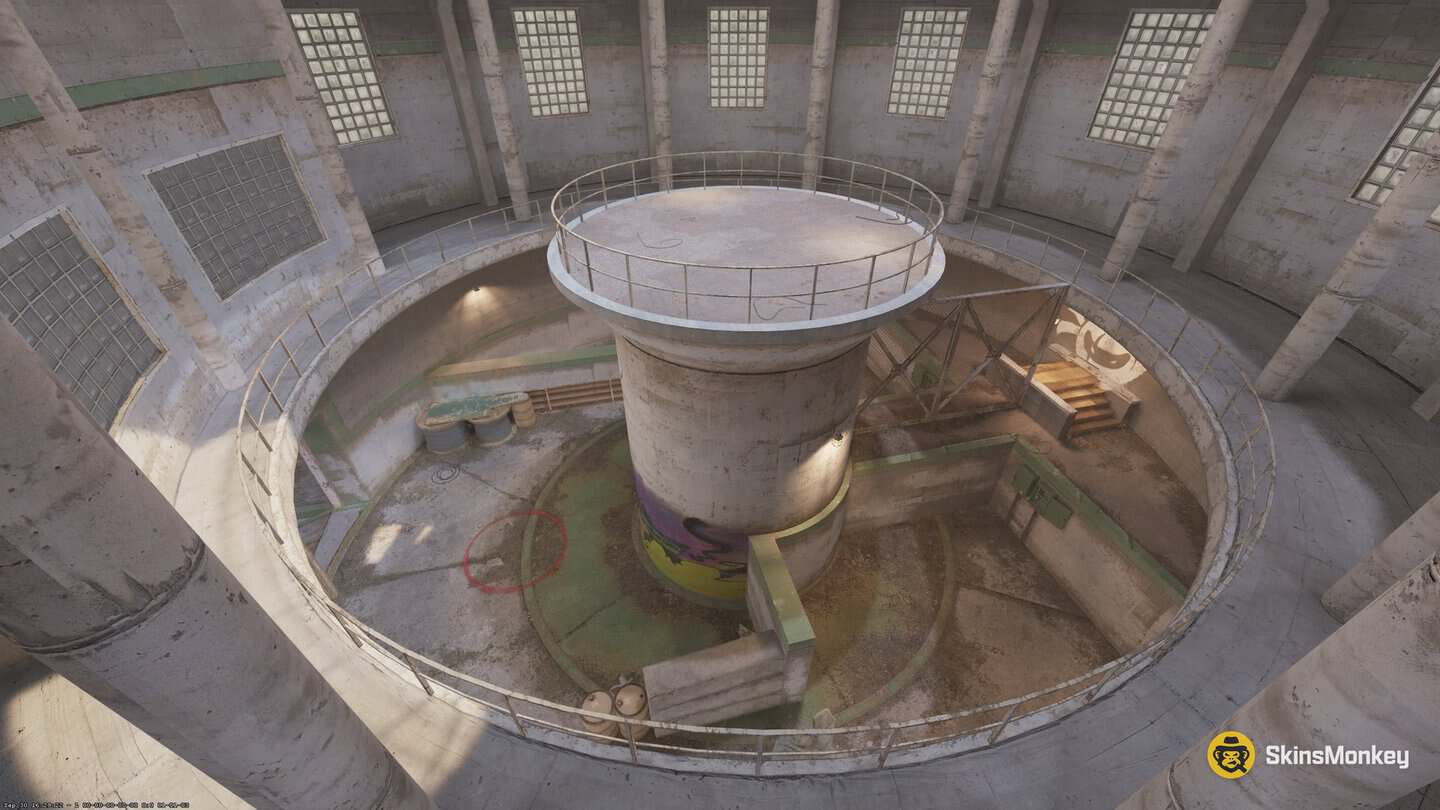
A round hall under a dome, with a thick pillar in the middle and a sunken water channel. The tower is next to the pillar, and the two spawns sit at either end of the hall's straight wall, closer to each other than in most arenas.
Dogleg
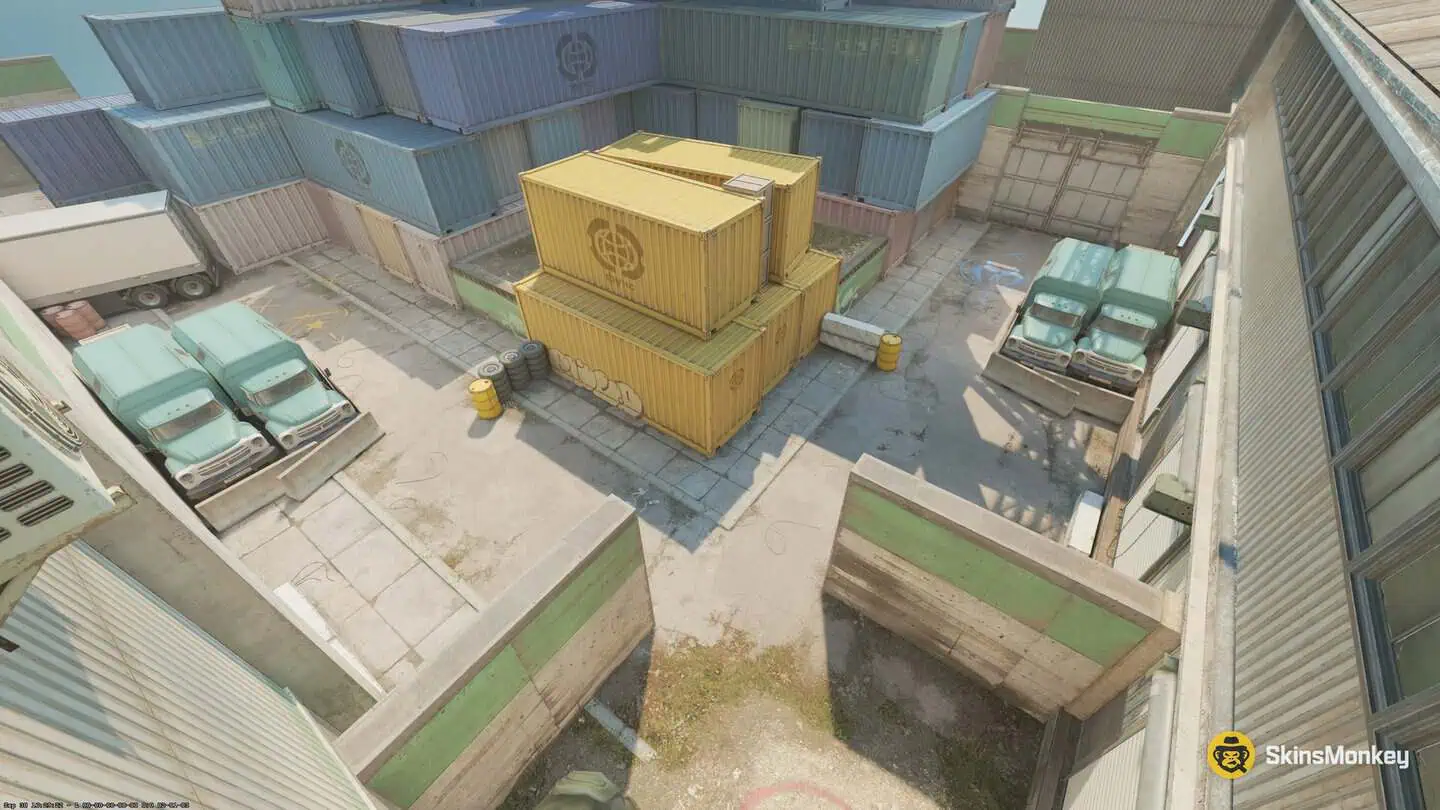
Shipping containers and trucks form an L-shaped yard. Each team starts at the end of one arm, and the tower sits at the bend, roughly the same distance from both.
Trainyard
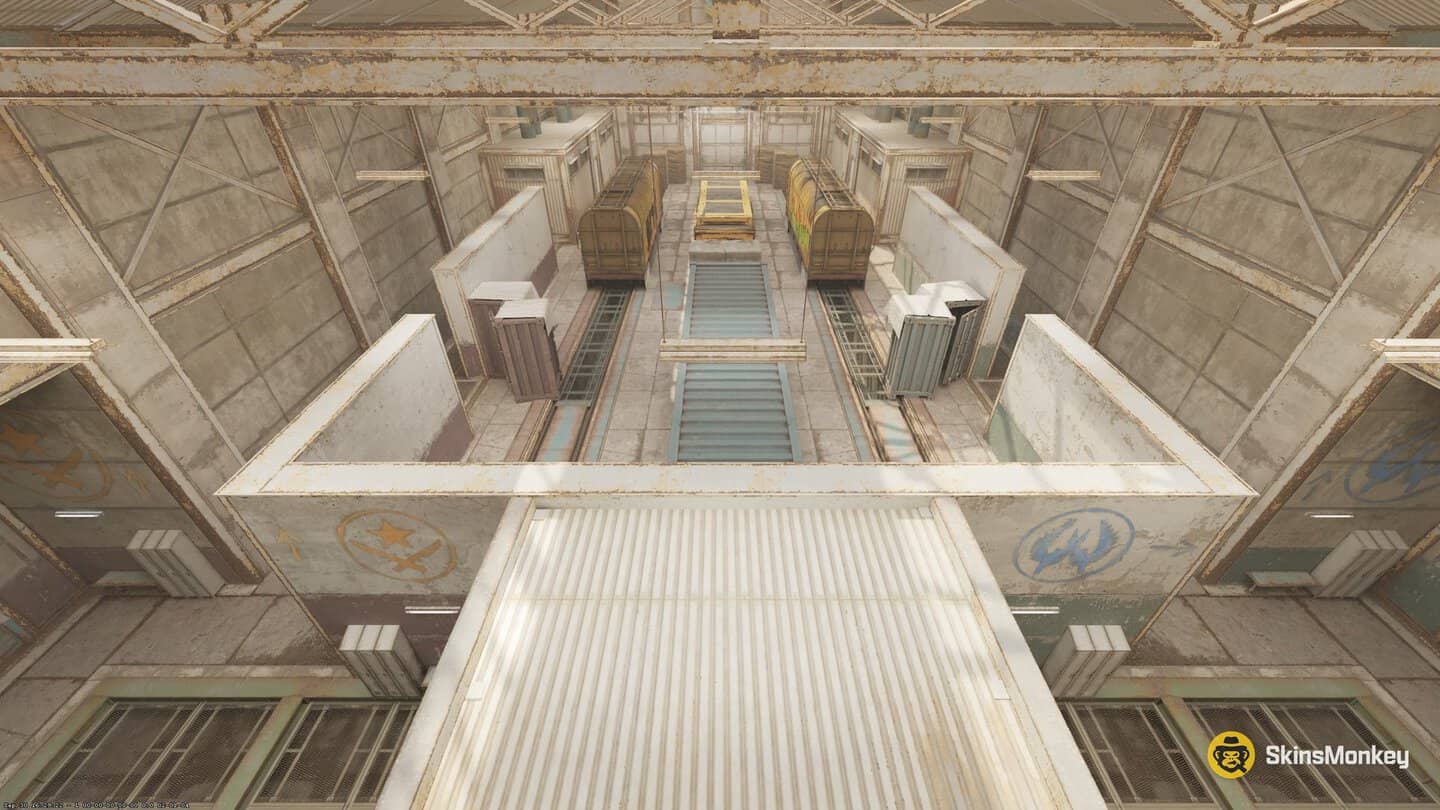
Long freight cars line a rail shed, and the lanes between them will remind you of B site on Train. Both teams spawn next to each other at one end, the closest start of any arena, but a wall and the middle row of cars hide them from each other until halfway down the shed. The tower is at the far end, so expect to hear the other team well before you see them.
Crane
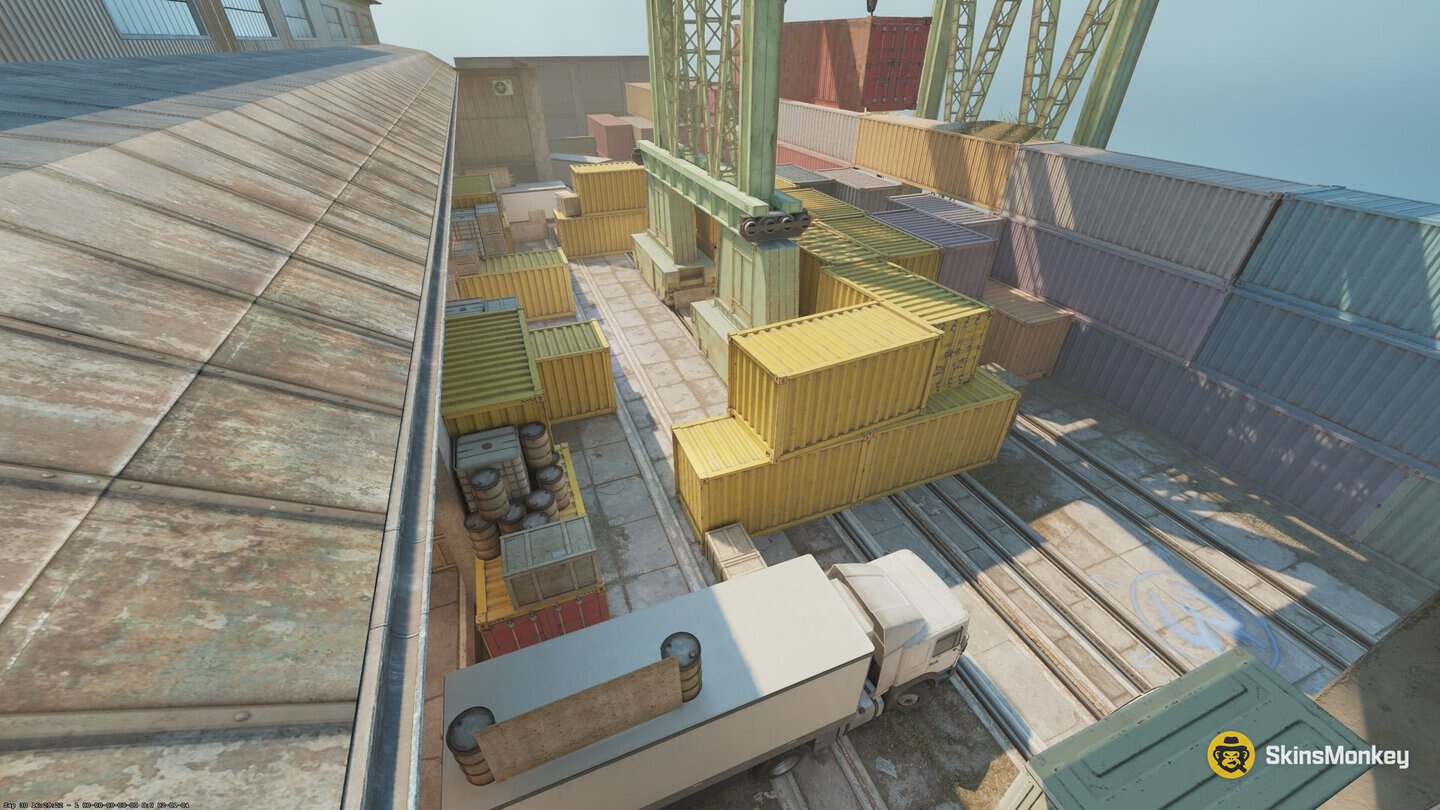
A gantry crane stands over a yard of containers. Both spawns are in the corners of one side, and the tower is across the yard between rows of containers. Among the standard arenas, only Steel puts the spawns farther apart.
Bloc
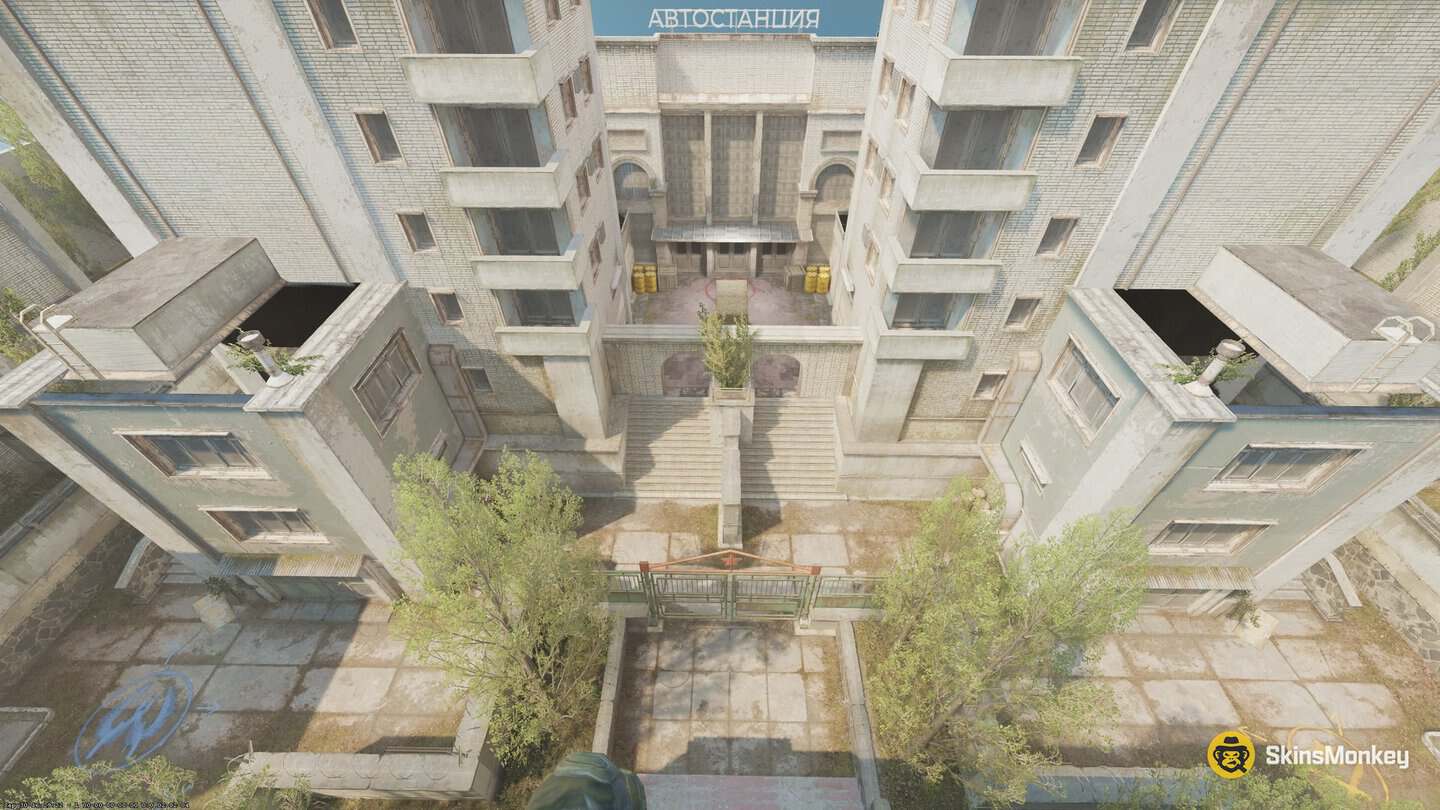
A courtyard between apartment blocks, with a bus station at the top. The teams start in the two bottom corners and push up a wide staircase to the tower, which sits above both of them.
Hydro
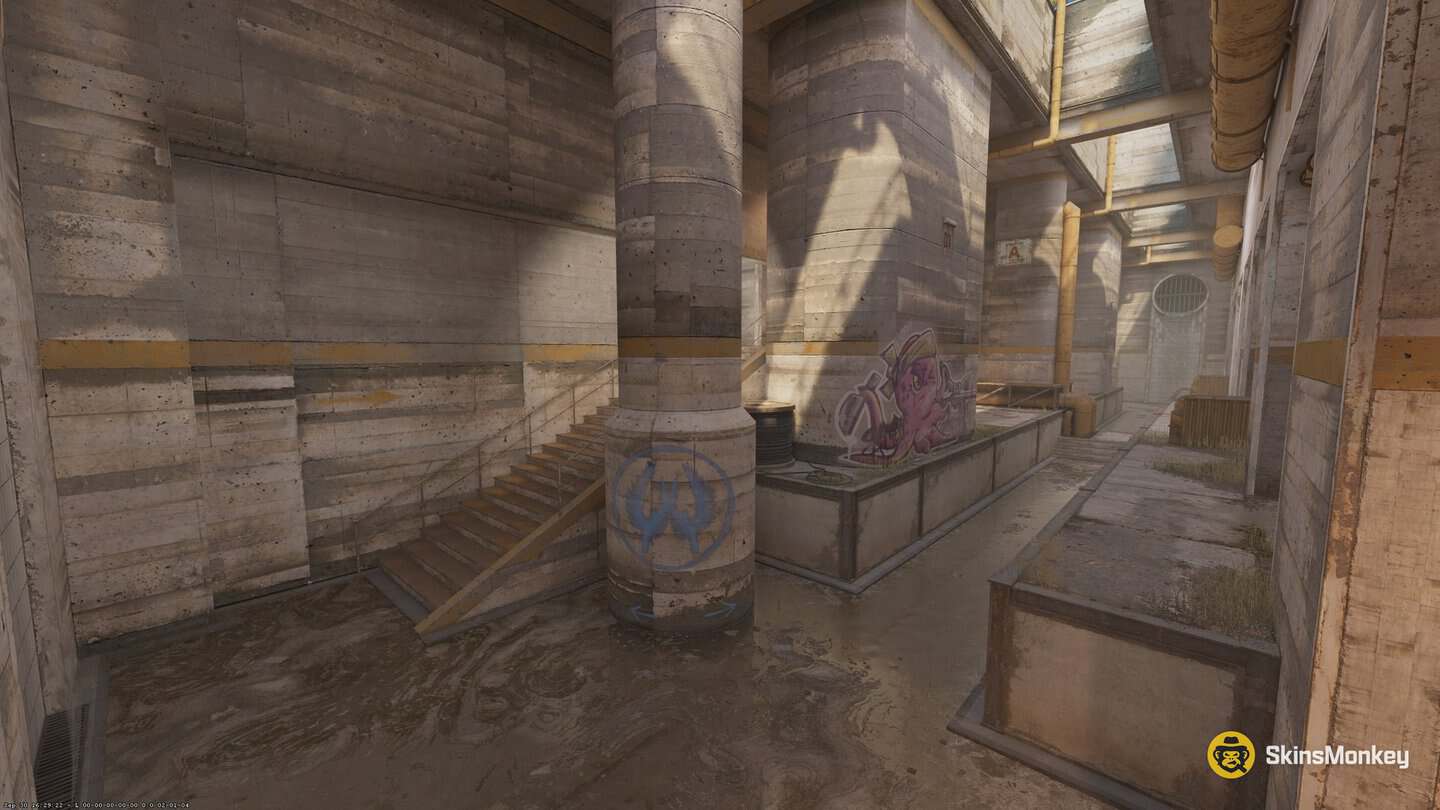
A long, narrow concrete hall with a water channel running along it. The spawns are at opposite ends and the tower is halfway along one side.
Atomic
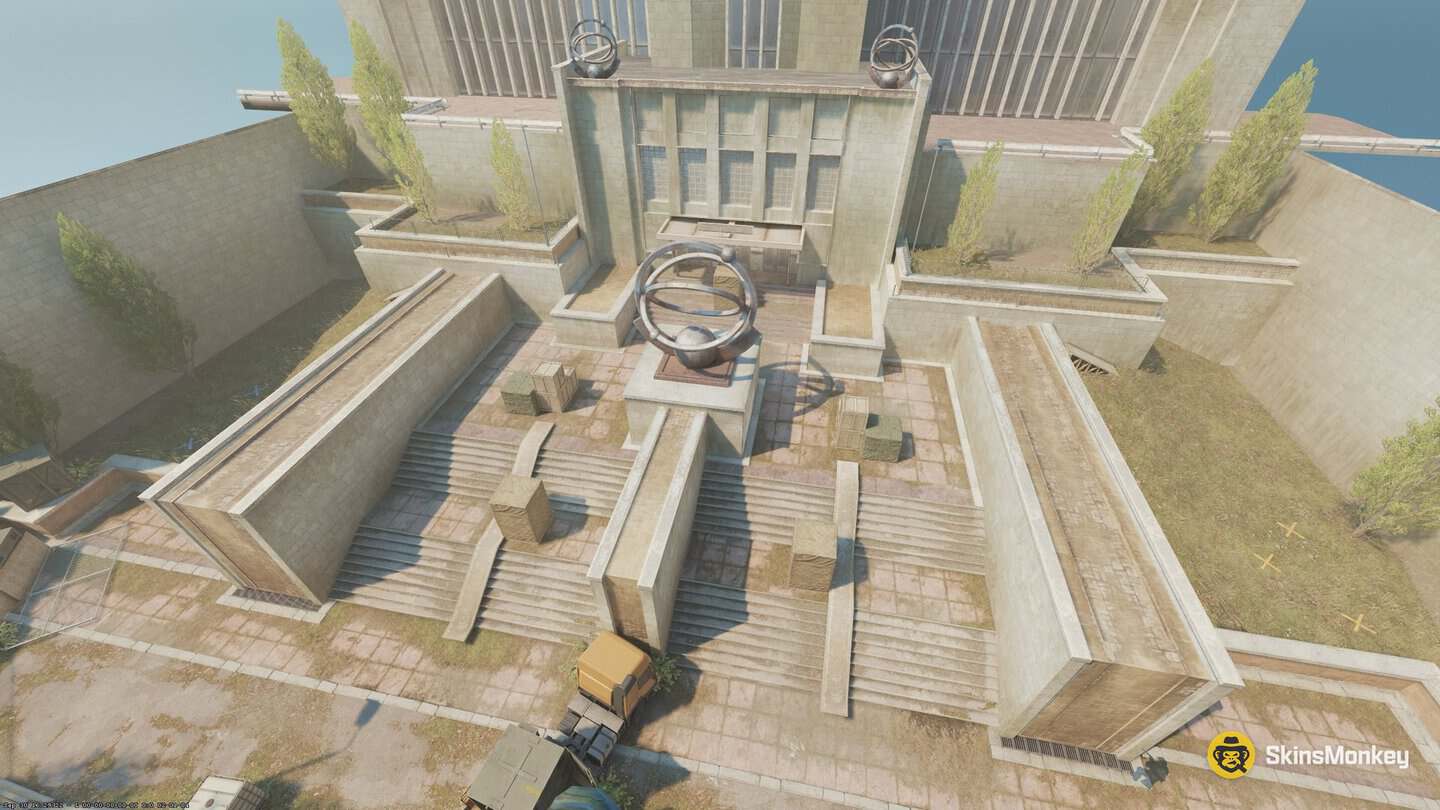
A plaza in front of a government building, with a big atom sculpture at the top of the steps. The spawns are at either end of the plaza, farther apart than in most arenas, and the tower stands between the sculpture and the building. Sightlines along the front of the building are long.
Medusa
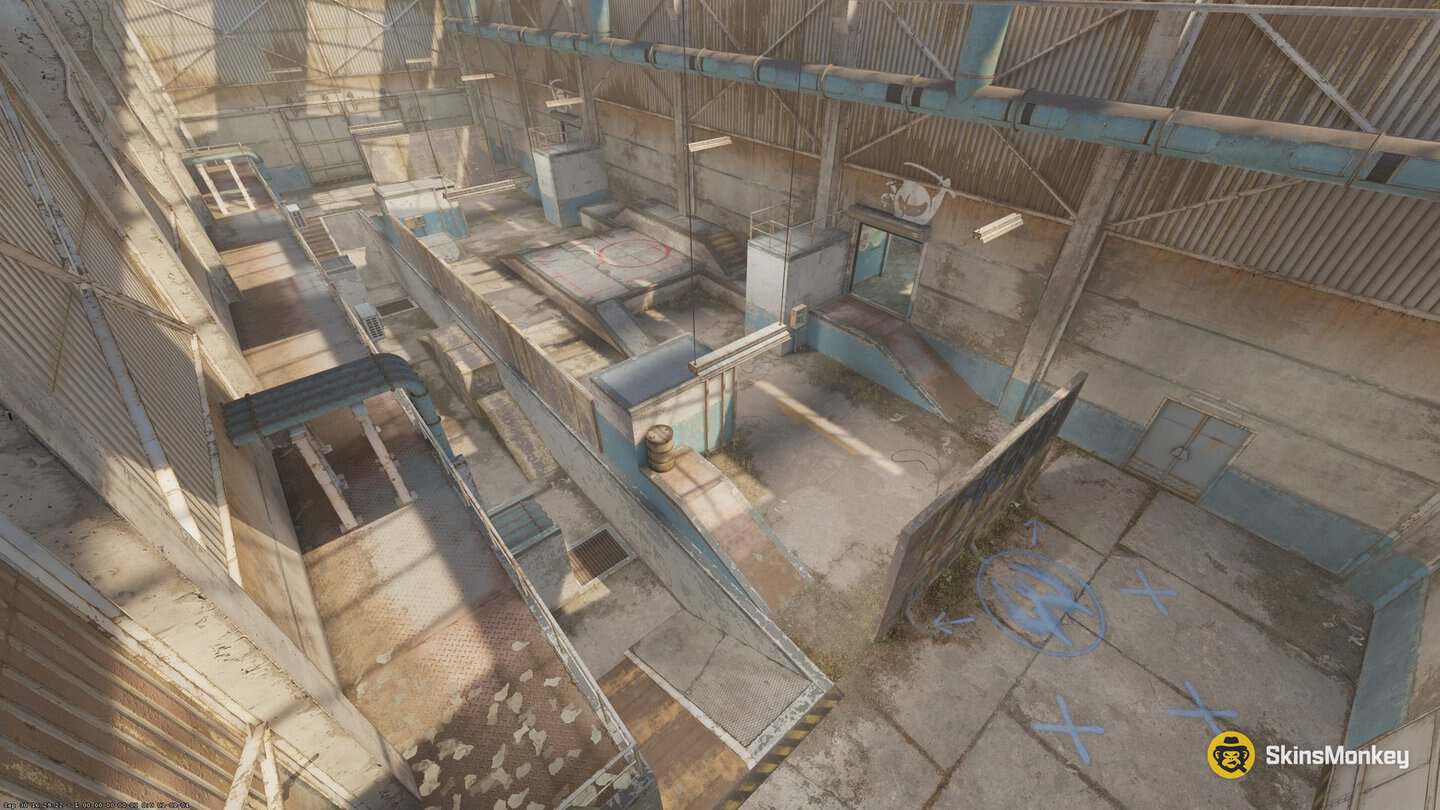
A factory hall with the tower on a low concrete platform in the middle and the spawns at opposite ends.
Bear
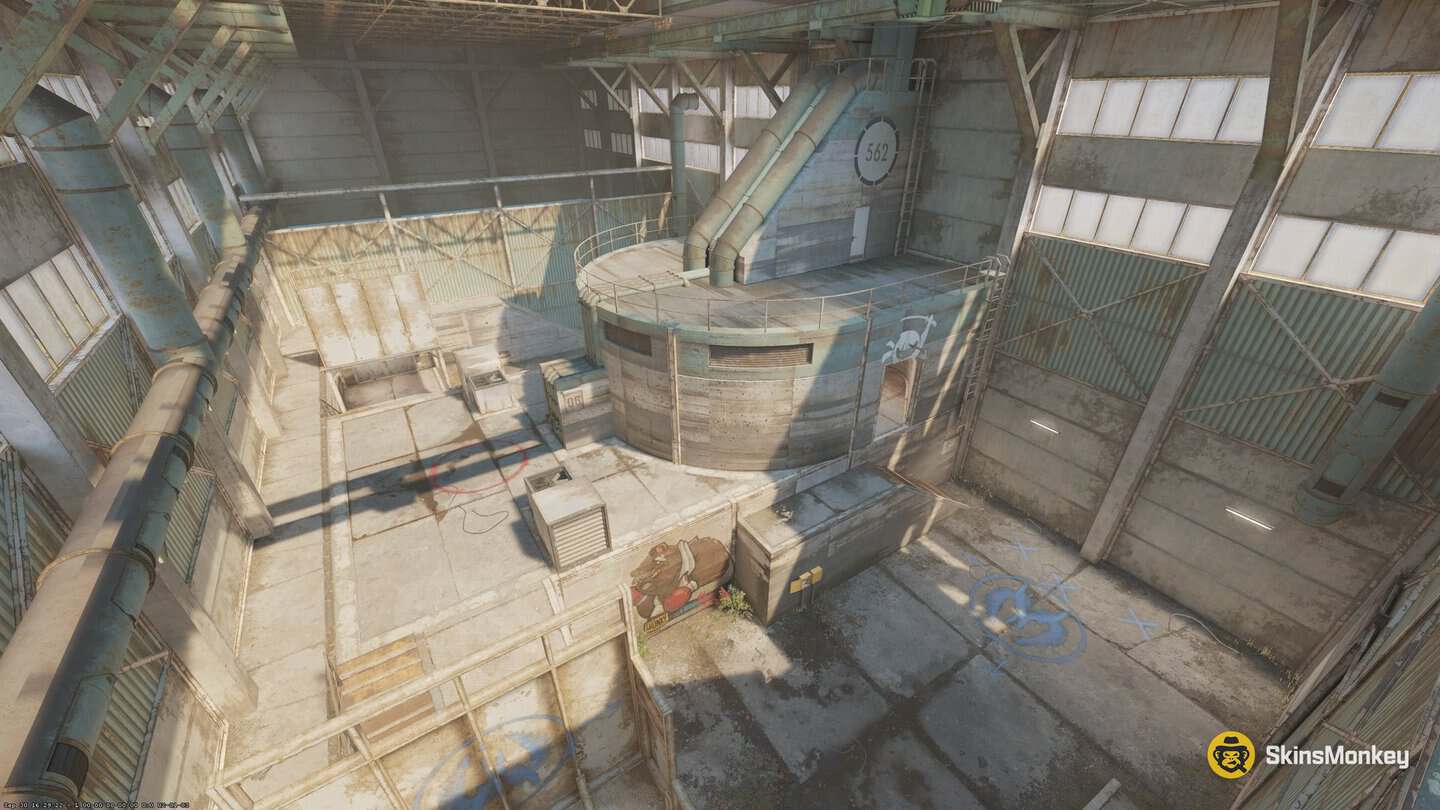
A horseshoe-shaped room wrapped around a solid core. The teams start at the bottom of the two legs, separated only by that core, and both have to climb to the tower at the top of the curve.
Steel
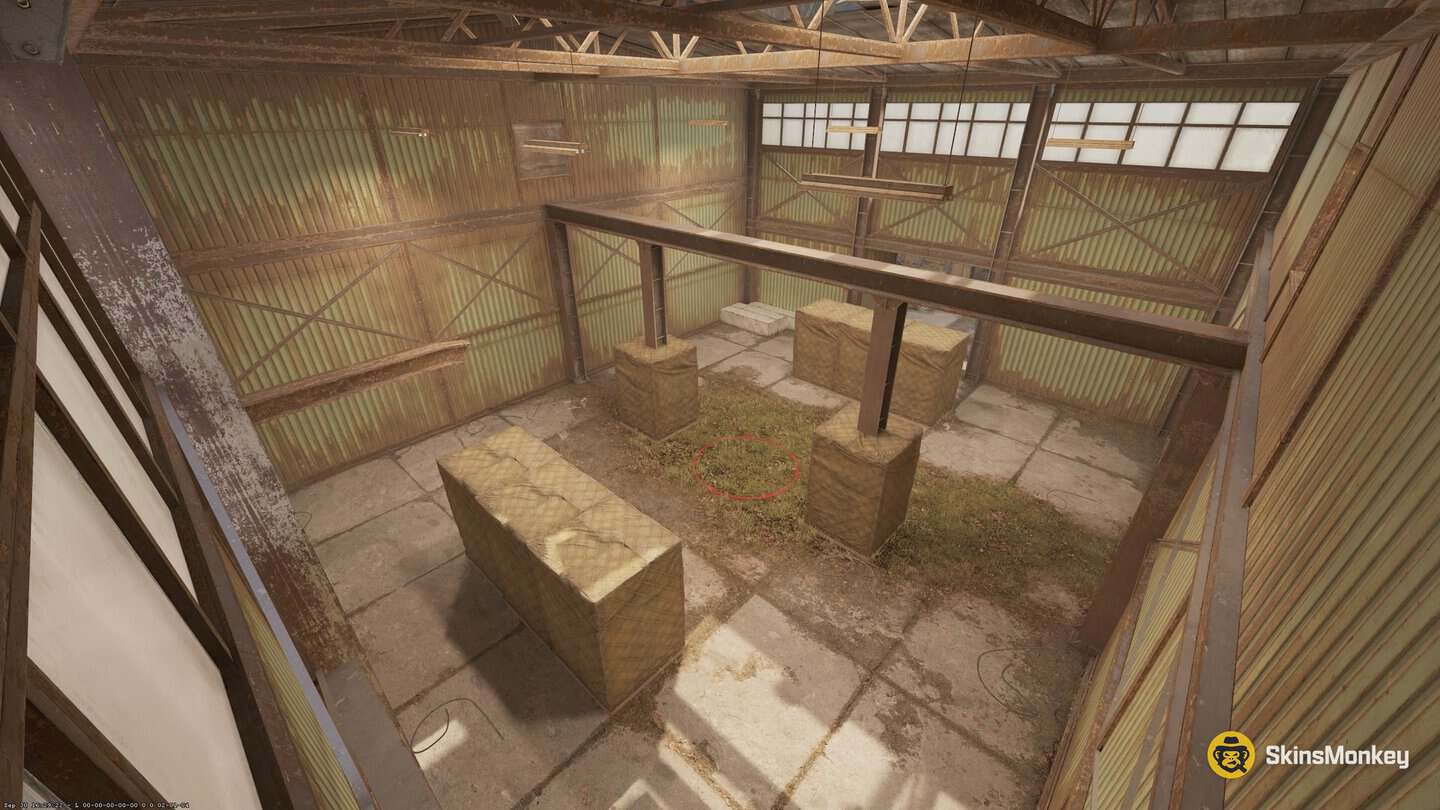
A corrugated-metal warehouse that looks like a scaled-down version of the one on Assault, with the tower in the middle of the floor and raised walkways along two walls. The spawns are in opposite corners of the yard outside, the widest gap of any standard arena.
Container
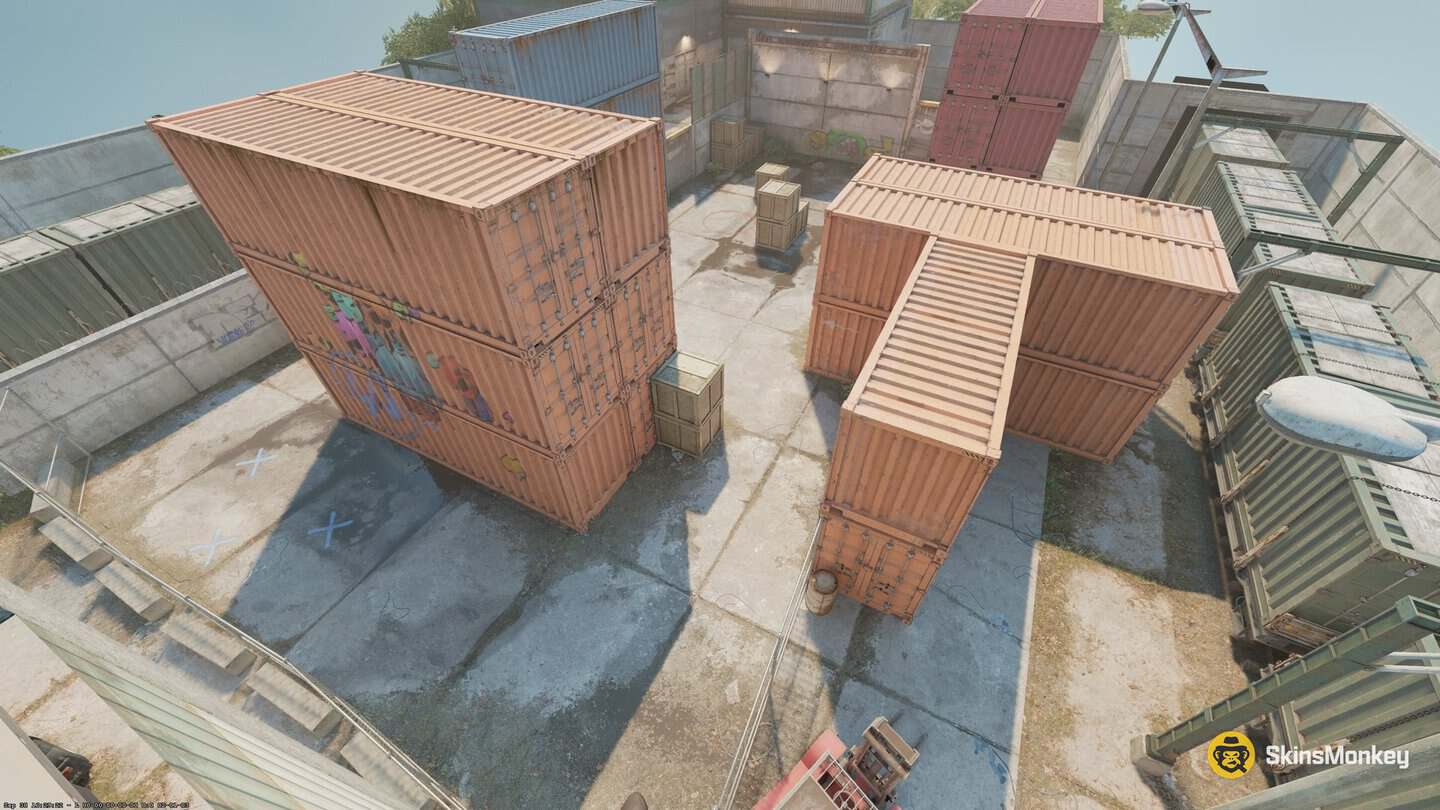
Stacks of shipping containers surround an open middle where the tower stands, with the spawns at opposite ends. A narrow corridor with stairs along one side gives you a close-range route around the yard.
Drop
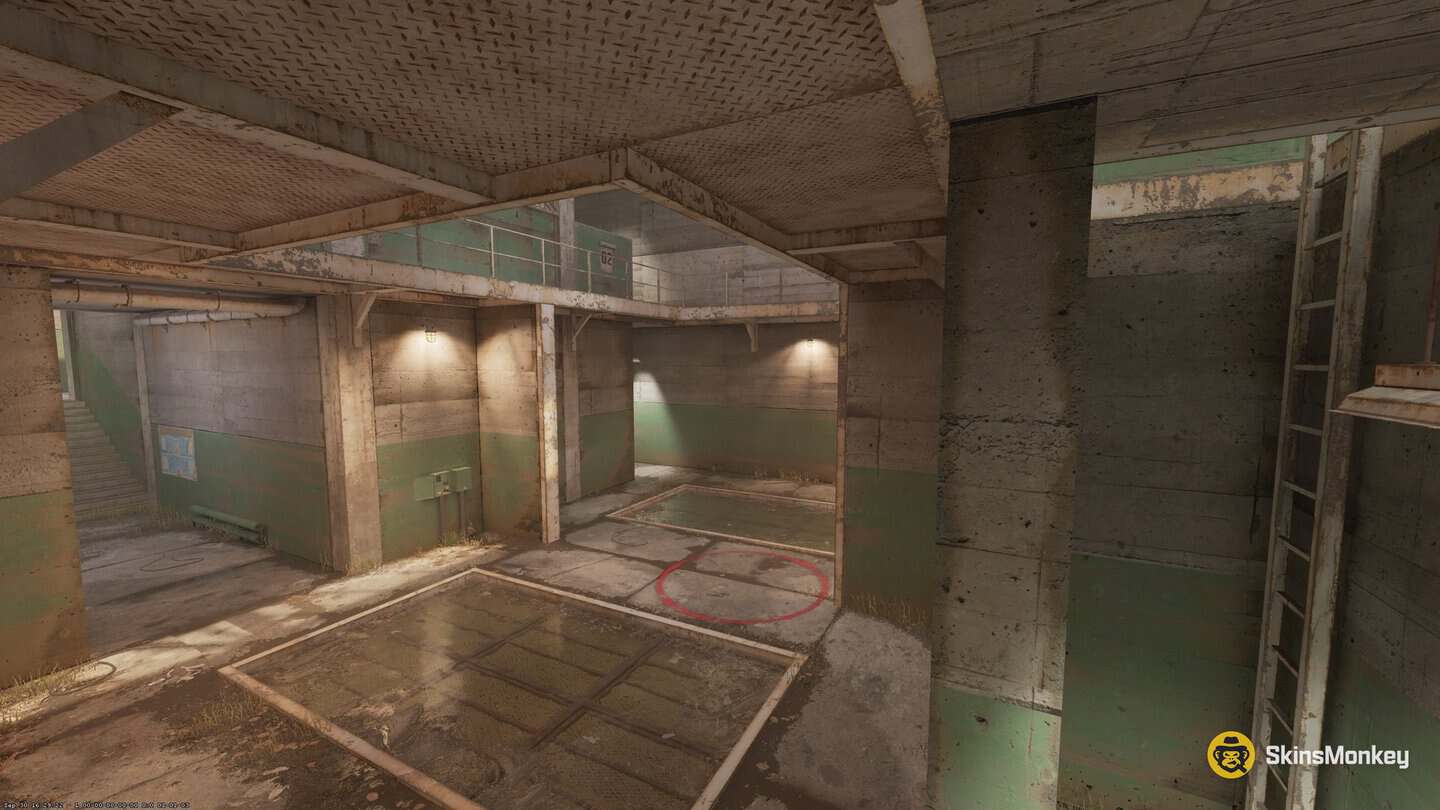
The floor of this long hall drops away in the middle. Both teams start on high ground at the ends, and the tower sits at the bottom of the dip, lower relative to the spawns than in any other arena.
Convoy (7:7 tiebreaker)
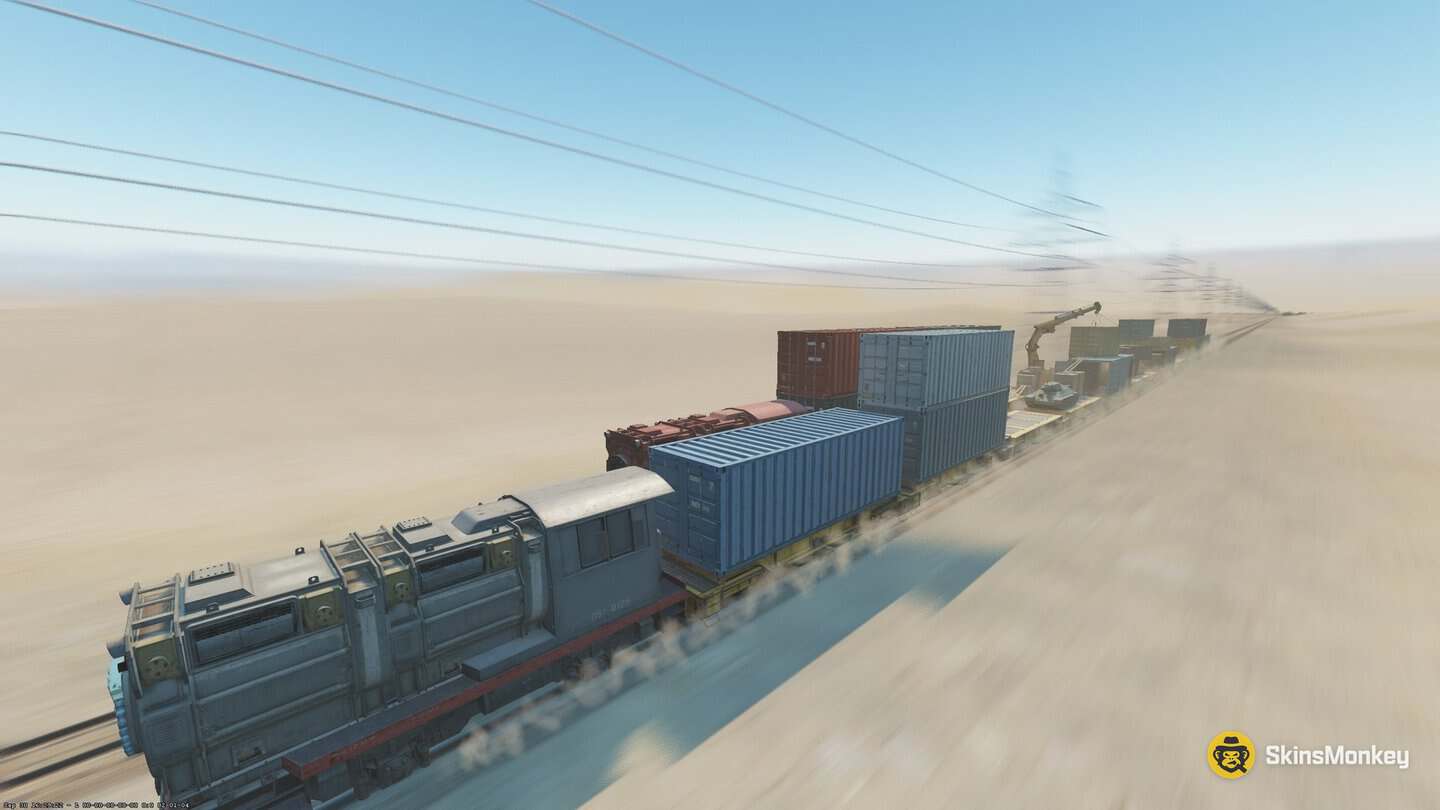
Two trains run side by side. The teams start at opposite ends of one train, the longest distance between spawns anywhere on Complex, with the tower halfway between them. The trains do not actually move: the scenery scrolls past and the ground under them works like a conveyor belt. Rounds here last 60 seconds, and attackers get up to 14 seconds to reach the tower after a wipe.
Rush Economy: $800 Start, $10,000 Cap and a Loss Bonus That Changes Every Buy
Valve's patch notes say only that each round gives you “a limited budget.” The figures below come from the mode's config as reported by Mythras, and Tradeit's guide lists the same ones, although nobody has published a full check of the loss bonus ladder in live matches yet. Our own HUD confirms the $2,500 round win (“+$2500 team income for eliminating the enemy team”) and a $300 kill reward (“+$300 for neutralizing an enemy”). Guides also disagree on the loss bonus cap: some say $4,350, others $5,100.
| Rush | Competitive | |
|---|---|---|
| Starting money | $800 | $800 |
| Money cap | $10,000 | $16,000 |
| Round win | $2,500 | $3,250 to $3,500 |
| First loss bonus | $2,100 | $1,400 |
| Loss bonus step | +$750 | +$500 |
The interesting line is the loss bonus. Its first step pays $2,100, only $400 less than a win, so losing barely dents your money and you can usually buy again right after a lost round. Saving is rarely worth it, because the $10,000 cap stops you from banking a big reserve anyway.
Two more rules from the config shape every buy. Each player can carry one grenade per round, of any type, so you choose between a smoke, a flash, a molotov and an HE rather than stacking them. Buy time is 15 seconds. Freeze time is 11 seconds, down from 13 at launch after Valve shortened it on September 23 (figures from Mythras).
Five Habits That Win Rush Rounds
Fight near the tower. With at most 7 seconds to touch the tower after a wipe, the best place to take the last duel is within a few steps of it. Chasing the final enemy into a far corner is how you lose a round you had won.
Pick your one grenade to suit the arena. In a small room, a single flash before you swing onto the tower is worth more than a smoke that blocks your own path. In the castles, where rounds last 60 seconds, a smoke to cross an open lane makes more sense.
Buy after a loss. The loss bonus is there to be spent. If your team saves while the other side full-buys on a bonus, you hand them the next arena.
Never peek alone. In 3v3, losing one duel costs you a third of your team. Swing in pairs and trade, because the tower rewards whoever has more players alive near it at the end.
Watch your spray. Friendly fire is on at one third of normal damage according to the config, and on September 24 Valve adjusted the rules for kicking players over team damage. Spraying through a teammate in a small arena is a fast way out of the match.
Silent reload, added in the same update, also fits Rush well. The arenas are small enough that a normal reload gives away your position, and holding the reload key swaps that for a slower, quieter one. On September 24 Valve closed two exploits around it: one that made reloads faster with a tap-then-hold trick and one that let shotguns fire faster.
Four Patches Since Launch: Every Rush Change So Far
All dates are in UTC, so in Europe some of these arrived after midnight, on the following day.
- September 23: the maximum post-elimination countdown in the end rooms and Convoy went from 7 to 14 seconds, the countdown no longer starts when a whole team dies to suicides, team kills or disconnects, and warmup, freeze time and technical timeouts got shorter. Valve also fixed map gaps and adjusted clipping.
- September 24: a better description of the rules on the loading screen, adjusted team-damage kick rules and clipping fixes.
- September 28: fixed pixel gaps in various Rush rooms and adjusted clipping in the T and CT castle rooms.
- September 30: more clipping fixes in the Rush maps. The same patch reworked crosshairs again, adding a Static Quadrant style, an outline color and a new share code format, which we cover in our CS2 crosshair update article.
None of these patches touched the economy, the eight-win limit or the arena pool. The changes so far cover timing, team-damage rules and map geometry, and the core rules in this guide have held since launch.
Valve Is Pushing Rush Hard, and Wingman Shows Where That Can Lead
Valve clearly wants people in this mode. Rush has its own tile in the main menu (“A new fast paced 3v3 mode”), and the weekly XP mission is built around it: win three matches of Rush on Complex for 750 XP. The tile also confirms two things the game files suggested: the map name Complex and the Atomic arena, whose atom sculpture is the tile's background.
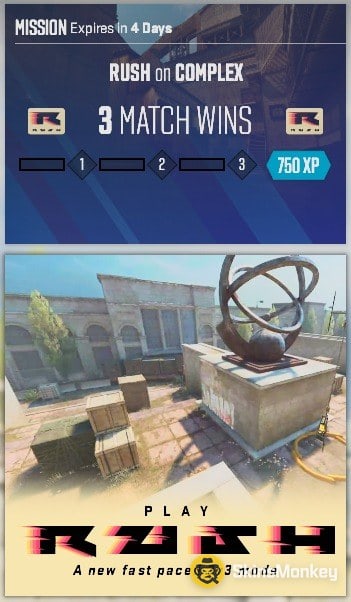
For now Rush has no CS Rating and no Skill Group. Valve's only progression feature is a friends leaderboard that counts your wins, so it is purely about bragging rights within your friends list. Parties of up to three can queue together.
We would not bet on it staying that way, and Wingman is the closest precedent. Valve added the 2v2 mode to CS:GO in May 2017 as part of Operation Hydra, with skill groups of its own from day one. When Hydra ended in November 2017, Wingman stayed in the game for good, and the November 14 patch notes added “Wingman-exclusive skill groups for better matchmaking in Wingman.” Rush launched without any rating at all, so it is starting from further back. Valve has said nothing about ranks for Rush, and this is our speculation, but a small-team mode that gets its own menu tile and a weekly mission is likely one Valve plans to keep, and the closest precedent, Wingman, kept its ranks when it became permanent.
Valve has not said whether Rush requires Prime either. Tradeit reports that, according to Steam Support, non-Prime accounts can play official modes other than Premier, but only Prime accounts earn XP and Weekly Drops, so the 750 XP mission reward needs Prime too. That matters more this season than usual, because the Weekly Drop is where the chicken eggs arrive. Our CS2 pets guide covers how hatching and feeding work. Some guides quote a fixed XP value per Rush round, but we could not verify it, so the 750 XP mission reward is the only XP number we are printing.
If you are coming from 2v2, Rush is a different game from Wingman. Wingman uses cut-down competitive maps, a bomb and a halftime. Rush has none of the three.
What Rush Means for Your CS2 Inventory
Rush does not drop anything new, and the leaderboard gives no rewards, so the mode on its own is unlikely to move skin prices the way a new case does. What it changes is how often you buy. With a loss bonus that pays almost as much as a win, we expect far fewer eco rounds than in Competitive, which means a rifle or pistol skin gets used in more rounds instead of sitting out a string of saves.
We think that makes Rush a good argument for a coherent mid-budget loadout over one expensive item and a row of default weapons. Our full CS2 inventory for $50 is a reasonable place to start. If Rush keeps its player base after the first weeks, demand for cheaper SMG and pistol skins could pick up, though nothing in the market data so far shows it. When you are ready to swap, you can trade your skins on SkinsMonkey with instant bot trades.
FAQ
How do you win a round in CS2 Rush?
You win a round by controlling the tower, either after eliminating the enemy team or when the timer runs out. Killing all three opponents is not enough on its own: your team then has up to 7 seconds (14 in the castles and Convoy) to get onto the tower. If time expires, the team holding the tower wins.
How many rounds is a Rush match?
A Rush match lasts at most 15 rounds. You win by taking a round inside the enemy castle, which needs a four-round lead, or by reaching eight round wins first. At 7:7 the deciding round is played in Convoy.
Is CS2 Rush ranked?
Not yet. Rush has no CS Rating or Skill Group, and the only tracking is a friends leaderboard that counts wins. Valve has not announced ranks. The closest precedent is Wingman, which had its own skill groups from its Operation Hydra launch in 2017 and kept them when it became a permanent mode.
Why are the Rush arenas different from Valve's poster?
The announcement graphic does not match the game files. The map script contains arenas such as Atomic, Medusa, Trainyard and Bloc that are not on the poster, while seven poster names, including Playhouse, Tunnel and King of the Hill, do not appear in the files (two of them, T Assault and CT Assault, are most likely the castles). The arenas you queue into follow the files.

A true gaming enthusiast, especially Counter-Strike: Global Offensive (CS2) and Rust. At SkinsMonkey, he is involved in creating game guides based on his own experience.